
Citrus Yield & Substitution Calculator
Recipes say "juice of 3 lemons" or "1/2 cup lime juice" and leave you guessing at the store. Tell this calculator what you need and it tells you how many fruits to buy, how much juice and zest a bag will give you, and what to swap when you run out.
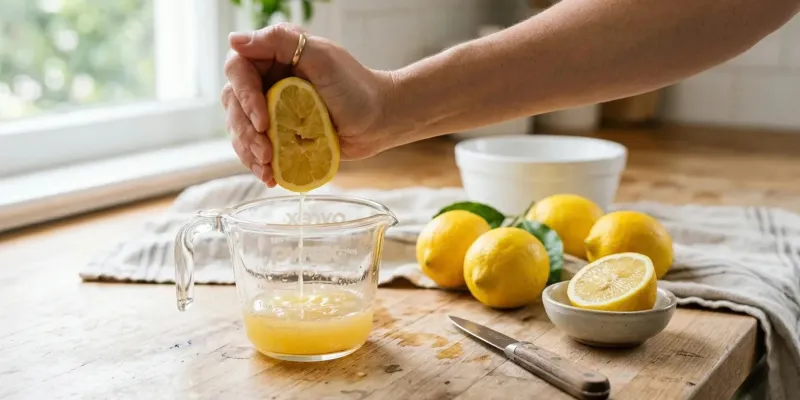
Quick answer: a medium lemon gives about 3 tablespoons of juice, so a cup of lemon juice takes about 5 or 6 lemons. A medium lime gives about 2 tablespoons.
Yields are typical values for fresh fruit and vary with variety, ripeness and how you squeeze. Buy one extra if the recipe is picky.
How many fruits for the juice you need
Medium-sized fruit. Small or dry fruit gives less, so round up.
| Fruit | Juice per fruit | For 1 tablespoon | For 1/4 cup | For 1/2 cup | For 1 cup |
|---|---|---|---|---|---|
| Lemon | about 3 tbsp | 1 lemon | 2 lemons | 3 lemons | 6 lemons |
| Lime | about 2 tbsp | 1 lime | 2 limes | 4 limes | 8 limes |
| Orange | about 5 tbsp | 1 orange | 1 orange | 2 oranges | 4 oranges |
| Grapefruit | about 12 tbsp | 1 grapefruit | 1 grapefruit | 1 grapefruit | 2 grapefruits |
What to use instead of lemon juice
The ratios below follow our guide to lemon juice substitutes, where you can read why each one works.
| Substitute | Ratio | Best for |
|---|---|---|
| Lime juice | 1 : 1 | Almost anything, savory or sweet. Closest match in tartness. |
| Orange juice | 1 : 1 | Baking, where extra sweetness is fine. Sweeter and less acidic. |
| Bottled lemon juice | 1 : 1 | Cooked dishes where freshness matters less. Flatter flavor than fresh. |
| White or apple cider vinegar | half as much | Savory cooking, when only acidity matters. Stronger and more pungent. |
| Rice vinegar | half as much | Delicate sauces and dressings. The mildest vinegar. |
| White wine | twice as much | Pan sauces and deglazing. Less acidic, so it takes more. |
| Lemon extract | 1 tsp per 2 tbsp juice | Baking, when you cannot add liquid. Adds flavor but little acidity. |
| Citric acid powder | 1/4 tsp per 1 tbsp juice | Baking, pickling, precise acidity. Dissolve in a little water. |
Where the numbers come from
Lemon sizes come from our own guide to how much juice is in one lemon. For orange, lime and grapefruit we anchor on USDA FoodData Central's juice yields (one lemon 48 g, one lime 44 g, one orange 86 g and one grapefruit 196 g of juice), converted to tablespoons. Key lime and mandarin figures are approximate. A tablespoon is 14.8 ml, and results are estimates because fruit varies. See the calories and nutrients for the juice on our lemon juice and lime juice pages.
Common questions
About 5 or 6 medium lemons, since a medium lemon gives roughly 3 tablespoons and a cup is 16 tablespoons. Plan on 4 large lemons or 8 small ones.
A medium lemon gives about 3 tablespoons (about 45 ml). USDA data lists 48 g of juice for one lemon. Small lemons give about 2 tablespoons and large ones about 4.
About 4 medium limes, at roughly 2 tablespoons each. Buy 5 if they feel light or small.
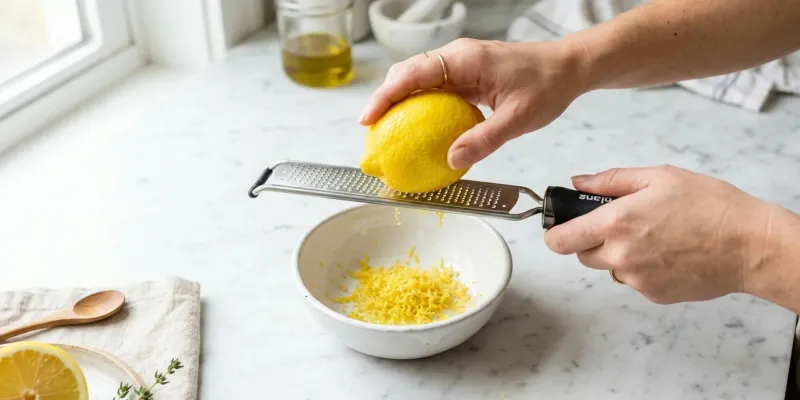
About 1 tablespoon, or 3 to 4 teaspoons, from one medium lemon. Zest it before you juice it, because a squeezed lemon is hard to grate.
Lime juice is the closest match at a 1 to 1 ratio. In cooking, half as much white or apple cider vinegar works when you only need acidity. For baking, lemon extract adds flavor without liquid. Use the Swap tab above for exact amounts.
Yield depends on the variety, ripeness and how you juice. Lemons that feel heavy for their size are juicier. Rolling them firmly on the counter, or warming them briefly, helps them give more. Buy one extra when a recipe is picky.
Related guides
Add this calculator to your website
Copy the code below and paste it into any page or blog post that accepts HTML. It is free, needs no sign-up, and updates automatically when we review the underlying research.
Why add it to your site
- It answers the question every citrus recipe raises: how many lemons or limes should I buy for this much juice or zest.
- Lemon sizes come from a published guide, and other fruits are anchored on USDA juice yields, so the numbers are checkable.
- The Swap tab turns a lemon juice amount into exact substitute amounts, which readers of any recipe blog will use.
- No sign-up, no email gate, and it works on phones.
Get the embed code
Embed code (keep the source line, it lets readers check the method)
<iframe src="https://zestandsqueeze.com/embed/citrus-yield-calculator" title="Citrus Yield & Substitution Calculator by Zest & Squeeze" width="100%" height="640" style="border:0;max-width:760px;" loading="lazy" referrerpolicy="origin"></iframe>
<p style="font-size:13px;">Source: <a href="https://zestandsqueeze.com/tools/citrus-yield-calculator">Citrus Yield & Substitution Calculator</a> by <a href="https://zestandsqueeze.com">Zest & Squeeze</a></p>Optional: auto-resize script
The calculator grows when results appear. Paste this once per page, after the embed, so the frame resizes instead of showing a scrollbar. It only reacts to messages from zestandsqueeze.com.
<script>window.addEventListener("message",function(e){if(e.origin!=="https://zestandsqueeze.com"||!e.data||e.data.type!=="zs-embed-height")return;var f=document.querySelectorAll('iframe[src^="https://zestandsqueeze.com/embed/"]');for(var i=0;i<f.length;i++){if(f[i].contentWindow===e.source)f[i].style.height=e.data.height+"px";}});</script>Preview: see how it looks on your page
Live preview of the embed at a typical content width.
Source: Citrus Yield & Substitution Calculator by Zest & Squeeze
By embedding, you agree to keep the source link visible. The tool is educational and not medical advice, and the embed says so. Questions or a custom size? Contact us.