
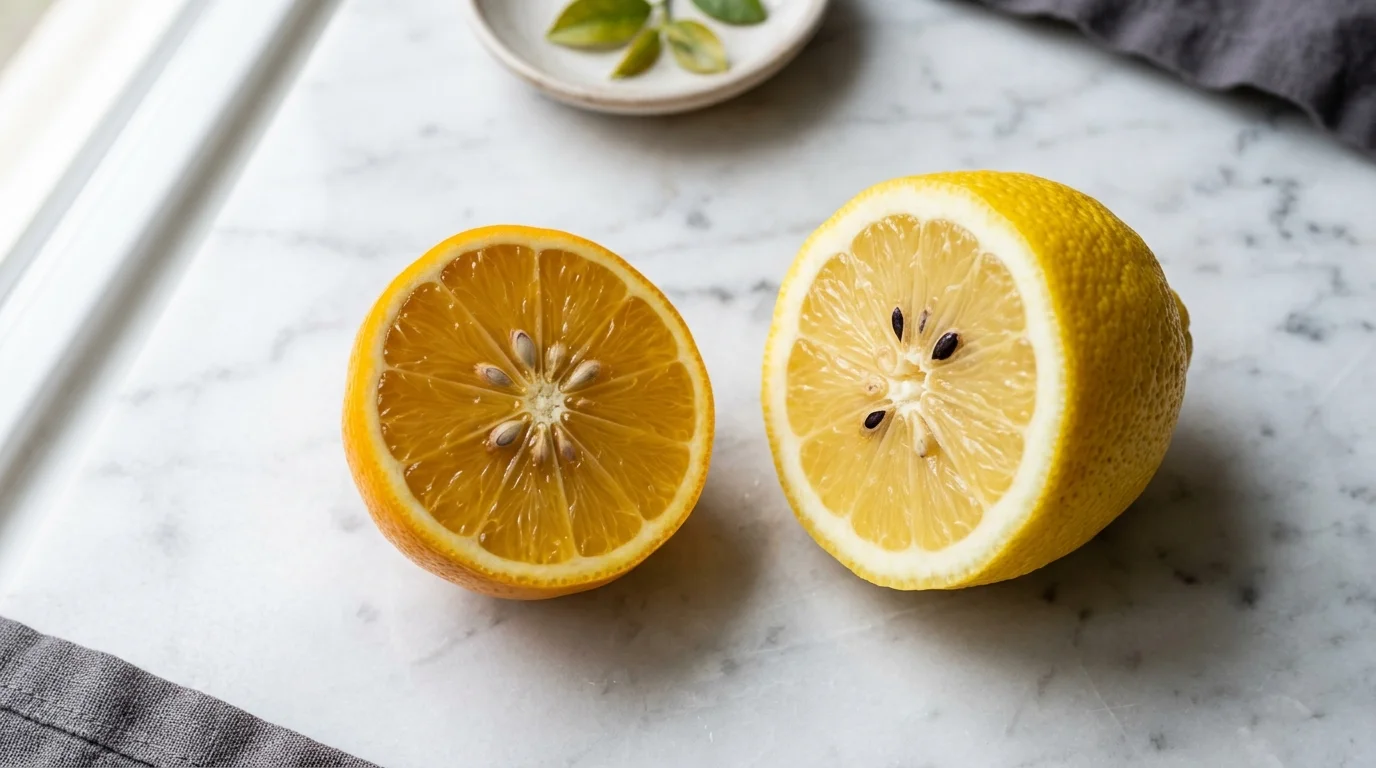
Quick answer: Meyer lemons are smaller, rounder, and sweeter than regular (Eureka or Lisbon) lemons, with thin, barely-there pith and a floral, almost mandarin-like flavor. Regular lemons are more acidic, more tart, and hold their shape better under heat, which is why most cooked and baked recipes are written for them by default.
The short version: a Meyer lemon is a sweeter, more fragrant, thinner-skinned cousin of the lemon you’ll find in most grocery store bins, and while you can usually swap one for the other, the recipe will taste noticeably different depending on which you use.
Where they come from
The lemon you buy most often, sometimes labeled Eureka or Lisbon, is what most people mean when they say “lemon.” The Meyer lemon is a different plant entirely: a citrus hybrid that originated in China and is believed to be a cross between a regular lemon and either a mandarin orange or sweet orange. It was brought to the US in 1908 and later refined into the disease-resistant variety most commonly grown today.
Appearance
Set them side by side and the differences are obvious:
| Regular lemon (Eureka/Lisbon) | Meyer lemon | |
|---|---|---|
| Shape | Oval, slightly pointed at the ends | Rounder, more like a small orange |
| Skin | Thick, bumpy, bright yellow | Thin, smooth, deep yellow-orange |
| Pith | Thick white layer | Barely any pith |
| Flesh | Pale yellow | Darker, almost orange-yellow |
That thin skin and minimal pith are also why Meyer lemon peel is more commonly eaten raw or candied, something you’d rarely do with a regular lemon’s thick, bitter pith still attached.
Flavor and acidity
This is the difference that actually matters in the kitchen. Regular lemons are highly acidic with a sharp, mouth-puckering tartness. Meyer lemons are moderately acidic and noticeably sweeter, with a more floral, almost herbal or spiced aroma that some describe as closer to bergamot than to a standard lemon. Because they’re less acidic, Meyer lemons alone won’t always deliver the same sharp brightness a recipe is counting on.
When to reach for which
Use a regular lemon when:
- The recipe depends on strong acidity to balance fat or sweetness, like a vinaigrette or a rich lemon curd
- You’re baking something where the tartness needs to cut through a lot of sugar, like a classic lemon pound cake
- You need the acid to help a dish set properly, since acidity affects how proteins and pectins behave when heated
Use a Meyer lemon when:
- You want a rounder, less sharply tart flavor, like in a delicate lemon icebox cake
- You’re eating the peel raw, in a salad or as a garnish, where a thick-pithed regular lemon peel would be unpleasantly bitter
- You’re making something where the lemon flavor should be more subtle and floral than aggressively sour
Substituting one for the other
If a recipe calls for regular lemon and you only have Meyer (or the reverse), you can generally swap them 1:1 by volume of juice, but expect the result to lean sweeter or more tart than intended. A common fix when using Meyer in place of regular: add a touch more juice than called for, or reduce added sugar slightly, to compensate for the lower acidity. Going the other direction, regular in place of Meyer, a small pinch of sugar can round out the sharper tartness.
Availability
Regular lemons are stocked year-round in nearly every grocery store. Meyer lemons are more seasonal, generally best from December through May, and more often found at farmers markets or specialty produce sections than in a standard bin. If you spot them in season, they’re worth grabbing for anything where lemon is meant to taste bright and floral rather than sharply sour.







Comments
Be the first to leave a comment.