
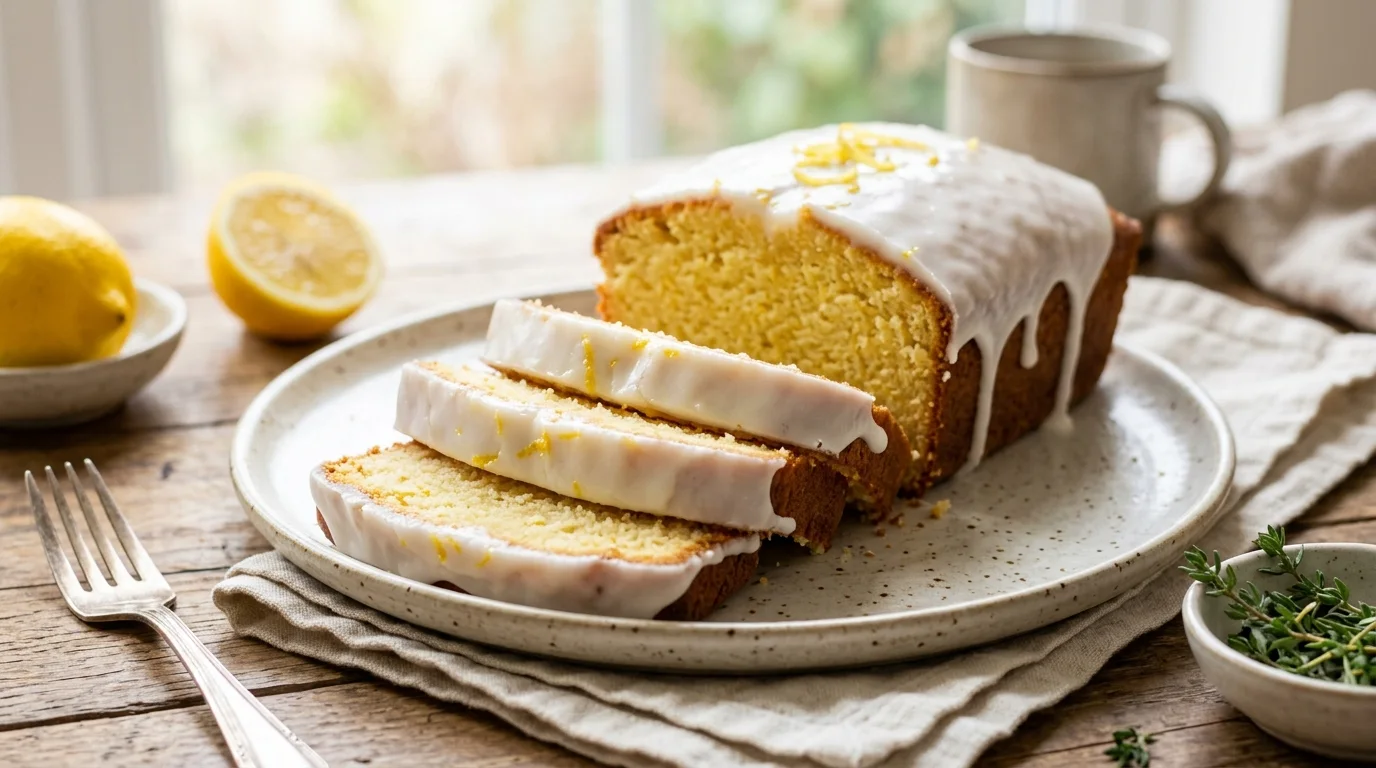
Quick answer: Starbucks' own published nutrition information lists their iced lemon loaf slice at about 410 calories, with 59g of carbs and 36g of sugar. A homemade copycat version, verified with a real ingredient-based nutrition calculator rather than a guess, computes to about 394 calories per slice, landing close to the original despite being baked completely from scratch.
Starbucks’ own published nutrition information puts their iced lemon loaf slice at around 410 calories. Our homemade, from-scratch version computes to about 394 calories per slice, using this site’s own ingredient-based nutrition calculator rather than a guess, landing close enough to the original that baking it yourself isn’t really a calorie-cutting move, it’s a control and freshness one.
The numbers side by side
| Starbucks (published) | Homemade (computed) | |
|---|---|---|
| Calories | ~410 | ~394 |
| Total fat | 17g | 14.2g |
| Saturated fat | 8g | 8.4g |
| Carbohydrates | 59g | 63.7g |
| Sugar | 36g | 44.1g |
| Protein | 5g | 4.2g |
The two land close on calories and total fat, with the homemade version actually running a bit higher on carbs and sugar, largely a function of how thick you pour the glaze, which is one of the easiest things to adjust yourself and impossible to adjust on a packaged slice.
Where each number actually comes from
The Starbucks figure is their own published nutrition information, a real, sourced number, not an estimate made for this comparison. The homemade figure isn’t a guess either: it’s computed directly from this recipe’s real ingredient quantities and weights, run through the same nutrition calculator used to verify every recipe on this site, built specifically after an earlier audit found that guessed nutrition numbers (here and across a lot of food blogs generally) are often wrong, especially anywhere a fat-heavy ingredient like butter is involved.
Why they land so close despite being made totally differently
A commercial bakery and a home kitchen use different exact ingredients, but the underlying structure of a dense, moist lemon loaf with a thick glaze is the same regardless of who bakes it: flour, sugar, butter or oil, eggs, a dairy component for moisture, and a glaze that’s mostly powdered sugar. Get those proportions in the same general range, which this recipe was built to do, and the calorie count converges naturally, without needing to reverse-engineer an exact proprietary formula.
How to make the homemade version lighter, if you want to
- Go easier on the glaze. It’s the single biggest sugar contributor in the whole recipe, and a thinner layer cuts real calories without changing the cake itself.
- Swap some butter for plain yogurt or applesauce. This reduces total fat while keeping the loaf moist, a common substitution in dense quick breads.
- Cut thinner slices. The simplest lever of all: a smaller serving has a smaller number, and a dense loaf like this one holds together fine in a slightly thinner cut.
The bottom line
If your goal is meaningfully fewer calories, this particular swap won’t get you there, the two versions are close enough that it’s not really a diet win. If your goal is knowing exactly what’s in your food, avoiding preservatives, or just having a fresh-baked version on hand without a store run, that’s where making it yourself actually pays off.





Comments
Be the first to leave a comment.